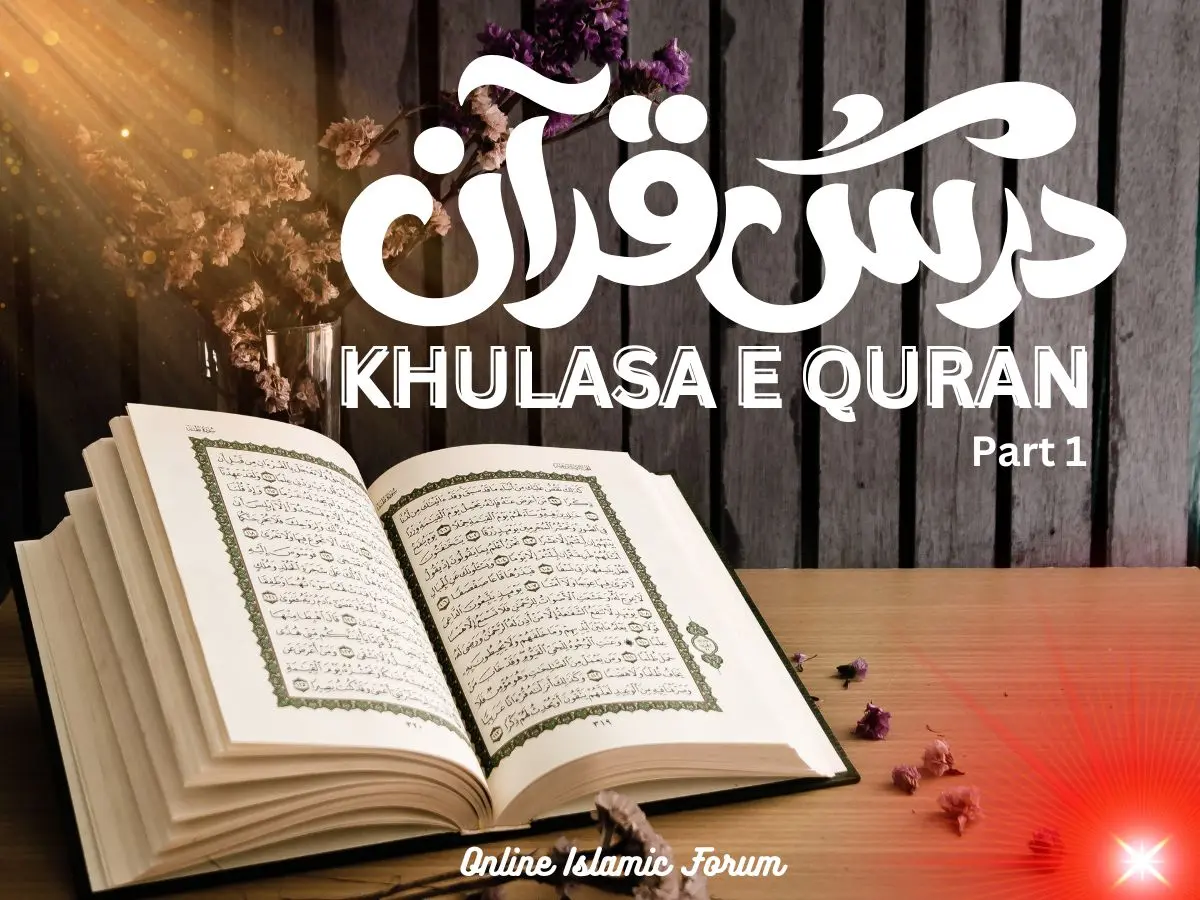

In this article, we will try to understand the Quran Summary verses 1 to 23 of Surah Fatiha and Surah Al-Baqarah. This is the first Surah of the Quran in order of order. Its importance can be gauged from the fact that its recitation is made obligatory in every rak’ah of every prayer.
This Surah consists of seven verses and in a Hadith Qudsi it is interpreted as “Salat”. Allah Almighty said, “I have divided the prayer between Me and My servant.” That is, when the servant says, “Alhamdulillah, Lord of the Worlds,” Allah Almighty says, “My servant has praised Me.” And when the servant says, “Al-Rahman, the Merciful,” Allah Almighty says, “My servant has praised Me.” And when the servant says, “Malik on the Day of Judgment,” Allah Almighty says, “My servant has glorified Me.” And when the servant says, “Iyyaka na’abdu wa’iyyaka nas’e’een,” Allah Almighty says, “This is shared between Me and My servant.”
Summary of up to 23 verses of Surah Al-Fatiha and Surah Al-Baqarah. To understand the khulasa e quran, it is important to consider these points.
That is, worship is only for Me. My help will be given to the servant who seeks help in every difficulty. And when the servant recites from “Ihdhinaa al-siraat al-mustaqeeem” to “Walaa al-dhaaliin”, since these are words of supplication and the servant is asking Allah Almighty to keep him on the straight path, then a call comes from Allah Almighty that this is for My servant and My servant has asked for this, it will be granted to him.” (Sahih Muslim: 877)
Surah Al-Fatihah is also mentioned by the names of Surah Al-Daa’, Surah Al-Shifa’, Surah Al-Kanz, Surah Al-Waqi’ah, Surah Al-Kafiyyah, Surah Al-Ruqyah and Surah Al-Hamd. It contains a statement of praise and glorification of Allah Almighty and His greatness, a statement that only He is worthy of worship, and that help should be sought from Him alone, and the manners of supplication and seeking refuge in Allah are described in it.
Surah Al-Baqarah: In the second verse of Surah Al-Baqarah, it is stated that if someone considers the evidence for the authenticity of the Quran with a cool heart, it will be clear to him that there is no room for doubt in this book.
The infidels and polytheists of Mecca denied that the Quran was the word of Allah and said that it was the word of the Holy Prophet (peace and blessings of Allah be upon him); Therefore, in verses 22 and 23 of Surah Al-Baqarah, all such opponents and deniers were challenged that if you doubt that the Quran is the word of Allah, then all of you together produce a word like it and there is no reference in history that this challenge of the Quran has been accepted.
Verses 3 to 5 mention the characteristics of the believers, belief in the unseen, establishing prayer, spending in the way of Allah, belief in the divine books and belief in the Hereafter.
Verses 5 and 6 mention those whose disbelief is obvious and they have gone so far in their rebellion that now it is practically impossible for them to find guidance and they have been sealed with eternal misery and misery.
Verses 8 to 20 mention the hypocrites. This is that section of humanity whose outward appearance is contradictory and whose inner self is contradictory. They claim faith for worldly gain but their hearts are devoid of faith.
In verses 21 and 22, the call to monotheism and the command to refrain from polytheism are given. The various blessings of Allah Almighty are mentioned and it is explained that the one who bestows blessings is Allah Almighty, He is the one who gives life and He is the one who gives death and ultimately everyone has to go to His court.
Conclusion
In the above passage, we have considered the khulasa e quran of verses 1 to 23 of Surah Fatiha and Surah Al-Baqarah. May Allah grant us the ability to act upon it.
Please express your opinion about the Drs e Quran series khulasa e Quran so that further improvements can be made in this regard. Also play your role in reaching out to your other Muslim brothers.
Recommended For You: