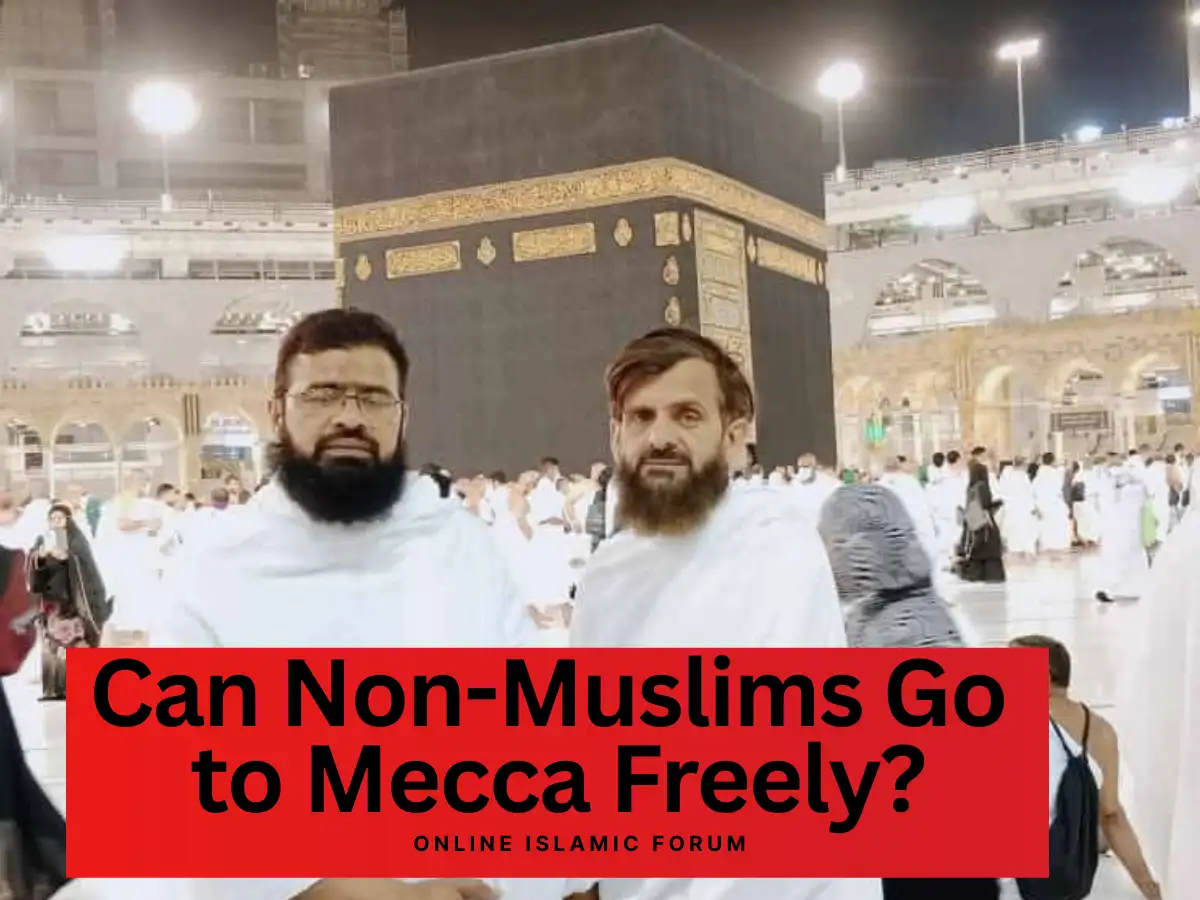

Can non-Muslims go to Mecca? This is one of the most searched religious questions in the world — and rightly so. Mecca is the holiest city in Islam, drawing millions of pilgrims from every corner of the globe. Yet there is a clear, firm rule that governs who may enter it. Understanding why this rule exists — and what it means in practice — takes us right to the heart of Islamic theology, history, and law.
What Is Mecca — and Why Does It Matter?
Mecca, situated in the Hejaz region of western Saudi Arabia, is the birthplace of the Prophet Muhammad ﷺ and the site of Al-Masjid al-Haram — the Grand Mosque, which contains the Kaaba. Muslims around the world face the direction of Mecca in every prayer, five times a day. It is the single most spiritually charged location in Islam.
The city is not simply a destination. It is the axis of Muslim worship itself. The annual Hajj pilgrimage, one of the Five Pillars of Islam, draws over two million Muslims every year. Nothing about Mecca is ordinary — and that is precisely why access to it is not ordinary either.
Can Non-Muslims Visit Mecca? The Direct Answer
No. Can non-Muslims go to Mecca? The answer is no, not under Saudi law and not according to the Islamic scholarly consensus upheld across fourteen centuries. The restriction applies to the entire city, with the Grand Mosque carrying the highest level of sanctity and the strictest prohibition.
Saudi Arabia enforces this through checkpoint systems on roads leading into Mecca. Signs clearly direct non-Muslims away. Violations can result in deportation, fines, or arrest. This is not a matter of custom or preference — it is enshrined in both Islamic legal tradition and modern Saudi national law.
The Qur’anic Foundation
Can Non-Muslims Go to Mecca? The prohibition is not arbitrary. It rests directly on revelation. Two Qur’anic verses make the principle clear:
Arabic: يَا أَيُّهَا الَّذِينَ آمَنُوا إِنَّمَا الْمُشْرِكُونَ نَجَسٌ فَلَا يَقْرَبُوا الْمَسْجِدَ الْحَرَامَ بَعْدَ عَامِهِمْ هَذَا
Transliteration: Yā ayyuhā alladhīna āmanū innamā al-mushrikūna najasun fa-lā yaqrabū al-masjida al-ḥarāma baʿda ʿāmihim hādhā
This verse, revealed in the ninth year after Hijra, formally established the sacred boundary. Scholars of fiqh universally cite it as the primary textual proof for the restriction on non-Muslim entry.
Arabic: إِنَّ الَّذِينَ كَفَرُوا وَيَصُدُّونَ عَن سَبِيلِ اللَّهِ وَالْمَسْجِدِ الْحَرَامِ الَّذِي جَعَلْنَاهُ لِلنَّاسِ
Transliteration: Inna alladhīna kafarū wa yaṣuddūna ʿan sabīli llāhi wa-al-masjidi al-ḥarāmi alladhī jaʿalnāhu li-n-nāsi
What the Hadith Say
The Prophetic traditions reinforce the Qur’anic ruling with great clarity.
Book: Sahih al-Bukhari | Hadith No.: 1622
Arabic: لَا يَحُجَّنَّ بَعْدَ الْعَامِ مُشْرِكٌ
Transliteration: Lā yaḥujjanna baʿda al-ʿāmi mushrik
Meaning: “After this year, no polytheist shall perform Hajj.” — This narration from the Prophet ﷺ, delivered through Ali ibn Abi Talib at Hajj, permanently established the exclusion of non-Muslims from the sacred pilgrimage and the holy city.
Book: Sahih Muslim | Hadith No.: 1347
Arabic: لَا يَدْخُلُ الْمَدِينَةَ الدَّجَّالُ وَلَا الطَّاعُونُ
Meaning: The Prophet ﷺ spoke of protecting the sanctified lands from corruption and impurity. Scholars apply the broader principle of ritual purity and sacred protection to Mecca directly.
Why Are Non-Muslims Not Allowed in Mecca? The Theological Reasoning
Many people — including non-Muslims who hold sincere respect for Islam — ask this question not out of hostility, but genuine curiosity. The answer lies in the concept of hurma (sanctity) and tahara (ritual purity).
According to Islamic law, the Haram (sacred precinct) is a place of divine presence and spiritual concentration. Entry is a privilege tied to faith, not simply geography. The restriction is not about race, nationality, or culture. It is about the sacred nature of the space and the conditions required to enter it.
Think of it this way: many traditions in every religion restrict access to their holiest places. The inner sanctuary of a Jewish temple, the inner rooms of certain Hindu temples, the most sacred Shinto shrines — all have entry conditions. Mecca operates on the same principle, applied at a city-wide level.
Are Only Muslims Allowed in Mecca? Understanding the Scope
Are only Muslims allowed in Mecca? Essentially, yes — but the word “Muslim” here includes every person who has declared the Shahada, regardless of background. A convert from Christianity, Judaism, Hinduism, or any faith tradition who sincerely accepts Islam can enter Mecca immediately. There is no waiting period, no ethnic requirement, no national restriction.
This is a point many people miss. The door is not ethnically Arab or Saudi or historically Muslim. It is open to any believer. The restriction is faith-based, not racial or cultural.
For deeper context on the history and theology of this rule, IslamQA and About Islam both offer well-sourced scholarly perspectives worth reading.
For further discussion on Islamic rulings in contemporary contexts, the community at www.onlineislamicforum.com hosts active conversations where scholars and students engage questions like this in depth.
The Hanafi Fiqh Position:
The Hanafi school — the largest school of Islamic jurisprudence globally, dominant across South Asia, Turkey, and Central Asia — affirms the prohibition clearly. According to Hanafi scholars, the prohibition is specifically tied to the Masjid al-Haram and extends, by scholarly consensus (ijma), to the entire city of Mecca.
For those studying the Hanafi fiqh perspective in depth, the following classical works address the rulings on sacred precincts and entry conditions:
- Radd al-Muhtar ʿala al-Durr al-Mukhtar (Ibn Abidin)
- Al-Hidayah fi Sharh Bidayat al-Mubtadi (Al-Marghinani)
- Al-Fatawa al-Hindiyya (compiled under Aurangzeb’s patronage)
- Bada’i al-Sana’i fi Tartib al-Shara’i (Al-Kasani)
- Tabyin al-Haqa’iq Sharh Kanz al-Daqa’iq (Al-Zayla’i)
These are available in Arabic and Urdu in most major Islamic libraries and academic archives.
What Happens If a Non-Muslim Enters Mecca?
In practice, Saudi authorities maintain checkpoints on the highways leading into Mecca. Signs in multiple languages clearly indicate restricted routes for non-Muslims. Visitors who enter without authorization — whether accidentally or deliberately — face deportation, legal penalties, or both.
There have been documented cases of non-Muslim journalists or researchers attempting to enter, sometimes in disguise. These cases typically resulted in expulsion. The Encyclopaedia Britannica’s article on Mecca notes the strictly enforced nature of this restriction as a defining feature of the city.
Is Madinah Also Restricted?
This question often arises alongside the question about Mecca. The answer is nuanced. Madinah’s Al-Masjid an-Nabawi (the Prophet’s Mosque) is restricted to Muslims. However, parts of the city of Madinah itself are accessible to non-Muslims, unlike Mecca, where the restriction applies to the entire city.
The distinction matters. Can non-Muslims go to Mecca? No, not anywhere in the city. Can non-Muslims go to Madinah — some areas, yes, but not the mosque itself.
Conclusion:
The question of can non-Muslims go to Mecca has a clear, consistent, well-documented answer: no. This ruling is rooted in Qur’anic revelation, affirmed by fourteen centuries of scholarly consensus, and enforced by Saudi law. It is not a political statement, a cultural prejudice, or an act of exclusion for its own sake.
It reflects a theological reality: Mecca is not simply a city. It is the beating heart of the Muslim world, a space of unmatched sanctity, where the conditions of entry are defined by the One to Whom that sanctity belongs. Understanding this is not just about knowing the rule — it is about understanding what Mecca truly means.
For Muslims, let this be a reminder of the blessing of Iman that grants you entry to the holiest place on earth. For non-Muslims, let it be a window into the depth of Islamic reverence for the divine. For more discussions on Islamic rulings and contemporary questions, visit www.onlineislamicforum.com.
FAQ Section:
Q1: Why can non-Muslims not go to Mecca?
The Qur’an (9:28) directly prohibits non-believers from the Sacred Mosque. Scholars have extended this ruling to the entire city to preserve its sanctity and ritual purity.
Q2: Can non-Muslims visit Mecca if they are curious or respectful?
No. Sincere respect, academic curiosity, or interfaith goodwill does not override the Islamic legal ruling or Saudi law. Entry requires the Muslim faith.
Q3: Are non-Muslims allowed in Mecca during emergencies?
In extremely rare, documented emergencies, non-Muslim workers — such as firefighters or medical crews — may receive temporary exceptional authorisation from Saudi authorities.
Q4: What if a non-Muslim converts to Islam — can they enter Mecca?
Yes, immediately. Once a person sincerely accepts Islam by declaring the Shahada, they are fully permitted to enter Mecca, perform Umrah, and undertake Hajj.
Q5: Is this rule specific to Saudi Arabia, or is it an Islamic religious requirement?
It is both. The Qur’an established the religious basis, and Saudi Arabia — as the custodian of the Two Holy Mosques — enforces it through national law. The two are aligned.
Recommended For You:
- Can A Muslim Marry A Christian?
- Can I Divorce My Wife For Not Sleeping With Me?
- Can I Kiss My Wife’s Private Parts in Christianity?
- A Continuous Charity: A Lasting Gift of Sadaqah
- Meaning 786 in Islam: Origins, Importance, and Guidance
- Allah Doesn’t Burden A Soul Beyond That It Can Bear
- Adoption in Islam: Muslim Needs to Know
- Tattoos Are Haram: The Islamic Perspective
- Major Sins in Islam