
Ahlul Bayt ۔ the blessed household of Prophet Muhammad ﷺ is a phrase every Muslim has heard. But here’s the truth: most of us don’t know enough about them. We say we love the Prophet’s family, yet we struggle to name more than two or three members. We’ve heard the term “people of the house,” but can’t fully explain what it means or why it matters so much.
That’s not a failure of faith. It’s a gap in knowledge — and one that’s very easy to fill. This article walks you through who the people of the house are, what the Quran and Hadith say about their status, and what that means for you as a Muslim living in the UK, USA, or anywhere else today.
📚 Want to go deeper? Browse highly rated books on the Prophet’s family and Islamic history on Amazon — excellent for both beginners and those seeking scholarly depth.
Who Exactly Are the Ahlul Bayt?
The phrase comes directly from the Quran (Surah Al-Ahzab, 33:33) and refers to the Prophet’s household. Classical scholars broadly agree on a core group. The Five of the Cloak — the Prophet ﷺ, Fatimah (RA), Ali (RA), Hasan (RA), and Husayn (RA) — represent the most cited inner circle. The Prophet’s wives are also included by many scholars based on the same Quranic verse.
Beyond that inner group, the broader Ahlul Bayt family tree extends to descendants of Banu Hashim — the Prophet’s clan within Quraish. This includes figures like Jafar ibn Abi Talib (RA), Abbas ibn Abd al-Muttalib (RA), and their descendants, who are known across the Muslim world today as Sayyids and Sharifs.
Core Members: A Quick Reference Table
| Member | Relationship | Notable Role |
| Fatimah al-Zahra (RA) | Daughter | Called “the Best of Women” by the Prophet ﷺ |
| Ali ibn Abi Talib (RA) | Son-in-law & cousin | Fourth Caliph, gateway to prophetic knowledge |
| Hasan ibn Ali (RA) | Grandson | Master of the Youth of Paradise |
| Husayn ibn Ali (RA) | Grandson | Martyr of Karbala, symbol of justice |
| Khadijah bint Khuwaylid (RA) | First wife | First Muslim, greatest supporter of Islam |
| Aisha bint Abi Bakr (RA) | Wife | Greatest female transmitter of Hadith |
| Abbas ibn Abd al-Muttalib (RA) | Uncle | Ancestor of the Abbasid Caliphate |
| Zaynab bint Ali (RA) | Granddaughter | Preserved the message of Karbala |
What the Quran Says About the Ahlul Bayt
The Quran doesn’t just mention the Prophet’s family in passing. Two verses in particular speak about them with remarkable directness — one about their spiritual purity, and one about our obligation to love them. Both are essential for any Muslim who wants to understand their religion deeply.
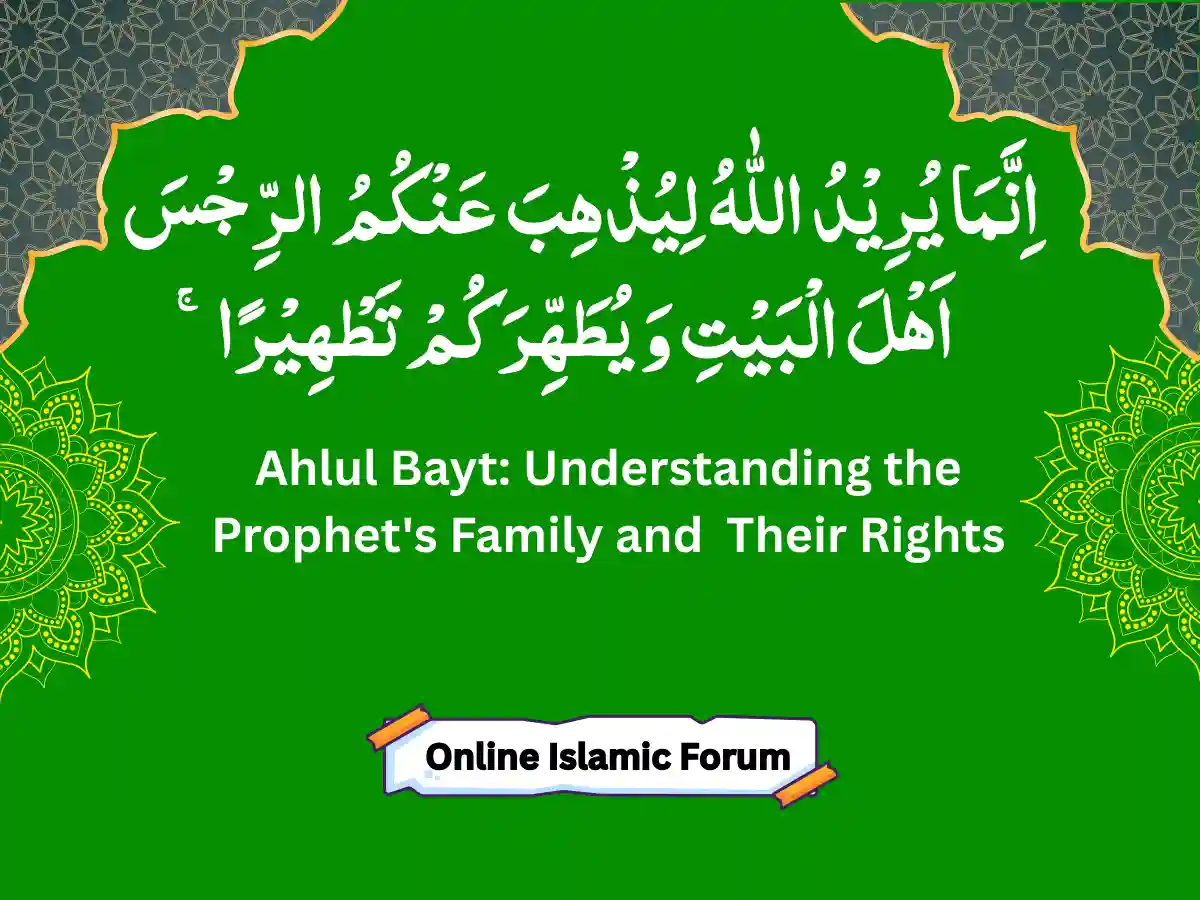
📖 Surah Al-Ahzab — Ayah 33 (33:33)
Transliteration: “Innama yureedu Allahu liyuzhhiba ‘ankumu al-rijsa ahla al-bayti wa yutahhirakum tatheeran.”
Translation: “Allah only intends to remove impurity from you, O People of the House, and to purify you with a thorough purification.”
🔗 Read Surah Al-Ahzab Verse 33 on Alim.org — the Verse of Purification
📖 Surah Al-Insan — Ayah 8 (76:8)
Transliteration: “Wa yut’imuna al-ta’ama ‘ala hubbihi miskeena wa yateeman wa aseera.”
Translation: “And they give food, despite their own desire for it, to the poor, the orphan, and the captive.”
This verse is widely understood by classical commentators to refer to Ali, Fatimah, Hasan, and Husayn (RA) during their famous act of selfless charity.
🔗 Read Surah Al-Insan Verse 8 on Alim.org — the verse scholars connect to the Prophet’s family
Hadith on the Status of the Ahlul Bayt
The Prophet ﷺ spoke clearly and repeatedly about the importance of his family. He didn’t leave it vague. Two narrations below — from different collections — show just how seriously he took their honour and the Muslim community’s responsibility toward them.
📚 Sunan Abu Dawood — Hadith No. 2277
The Prophet ﷺ said: “Verily, I am leaving among you two weighty matters — the Book of Allah and my family. Watch carefully how you treat them after I am gone.”
This Hadith, narrated in multiple collections, establishes the Ahlul Bayt as a lasting trust upon the Muslim ummah.
🔗 Read this Hadith on Sunnah.com — the Prophet’s bequest regarding his family
📚 Jami’ at-Tirmidhi — Hadith No. 3719
The Prophet ﷺ said about Husayn (RA): “Husayn is from me and I am from Husayn. Allah loves whoever loves Husayn.”
A deeply personal statement — showing that love for the Prophet’s family is love for the Prophet himself.
🔗 Read the Prophet’s love for Husayn ibn Ali in Tirmidhi on Sunnah.com
Why Their Status Matters — Real Benefits for Muslims Today
Some Muslims treat the love of the Prophet’s family as something decorative — a cultural add-on rather than a core religious commitment. That’s a mistake. The Quran and Sunnah are clear that this love has meaning, weight, and real consequences for how we understand Islam.
Here’s what honouring the people of the house actually gives you in your spiritual life:
- A Complete Salah — The Salawat Ibrahimiyyah, recited in every prayer, explicitly asks Allah to bless the Prophet’s family. Knowing who they are makes that supplication alive.
- Moral Benchmarks — Fatimah’s patience, Husayn’s courage, Ali’s wisdom — these are not historical trivia. They are patterns for Muslim life.
- Prophetic Nearness — The Prophet ﷺ said whoever loves his family loves him. Closeness to the Prophet is closeness to Allah.
- Historical Literacy — Understanding the Ahlul Bayt family tree helps you follow Islamic history, fiqh schools, and theological discussions with much greater clarity.
- Unity — Respect for the Prophet’s household is a rare point where Sunni and Shia Muslims find common ground. That matters in diverse Muslim communities across the UK and the USA.
For a thorough historical overview, the Wikipedia entry on Ahl al-Bayt covers different scholarly perspectives and classical definitions across Islamic traditions.
The Ahlul Bayt Family Tree through History
After the death of Husayn (RA) at Karbala in 680 CE, the Prophet’s lineage continued through his surviving children and grandchildren. Husayn’s son, Ali Zayn al-Abidin (RA), carried the line forward, giving rise to a long chain of Imams revered in Shia Islam and respected widely in Sunni tradition.
The Hasan (RA) line spread across Arabia, North Africa, and eventually South Asia. Today, there are tens of millions of Sayyids — descendants of the Prophet ﷺ — living in countries from Morocco to Pakistan to Indonesia. In the UK and USA, South Asian and Arab Muslim communities often include Sayyid families who trace their lineage directly back to Hasan or Husayn (RA).
The Ahlul Bayt Legacy Timeline
| Era / Event | Key Figure | Significance |
| 570–632 CE (Prophetic Era) | Prophet Muhammad ﷺ | Foundation of Islam and the household |
| 656–661 CE | Ali ibn Abi Talib (RA) | Fourth Caliph; preserved prophetic knowledge |
| 680 CE (Karbala) | Husayn ibn Ali (RA) | Martyrdom that shaped Islamic conscience |
| 8th–9th Century | Imam Jafar al-Sadiq (RA) | Major contributor to Islamic jurisprudence |
| 909–1171 CE | Fatimid Caliphate | Caliphate claiming descent from Fatimah (RA) |
| Present Day | Global Sayyid families | Living continuation of the Prophet’s lineage |
For a well-sourced academic perspective, the Encyclopædia Britannica article on Ahl al-Bayt provides an excellent contextual summary from a neutral scholarly lens.
Hanafi Fiqh Books Addressing the Rights of the Prophet’s Family
Classical Hanafi scholarship includes a detailed discussion of the status, rights, and special rulings related to the Banu Hashim and the Prophet’s descendants. These titles are worth exploring:
- Mukhtasar al-Quduri — by Ahmad ibn Muhammad al-Quduri
- Al-Mabsut — by Imam Shams al-A’immah al-Sarakhsi
- Badai al-Sanai fi Tartib al-Sharai — by Imam Ala al-Din al-Kasani
- Al-Ikhtiyar li-Ta’lil al-Mukhtar — by Abdullah ibn Mahmud al-Mawsili
- Durr al-Mukhtar — by Ala al-Din al-Haskafi
These classical texts are available in major Islamic libraries, archives, and some digital platforms. Always consult a qualified scholar for personal rulings.
A Simple Checklist: How to Honour the People of the House
Daily Habits to Connect with the Ahlul Bayt:
- Recite the full Ibrahimi Salawat in every prayer — don’t rush through it.
- Learn at least one story from the life of Fatimah (RA) or Husayn (RA) this week.
- When meeting a Sayyid, show appropriate respect — the Prophet ﷺ taught this.
- Teach your children the names of the Prophet’s family as early as possible.
- Read a reliable book on Islamic history that covers the early caliphate period in depth.
- Explore discussions with other Muslims at Online Islamic Forum — a great space to learn and share.
For well-researched articles on the Prophet’s family and broader Islamic topics in English, About Islam is a trusted platform used widely by Muslim converts and English-speaking Muslims in the West.
Frequently Asked Questions
Q1: What does “Ahlul Bayt” literally mean in Arabic?
It means “People of the House.” In the Islamic context, it refers specifically to the household and close family of Prophet Muhammad ﷺ.
Q2: Why do Muslims send blessings on the Prophet’s family in Salah?
Because the Prophet ﷺ himself instructed it. The Salawat Ibrahimiyyah includes his family as an act of honour and following Sunnah.
Q3: Does the Ahlul Bayt family tree include all of the Prophet’s companions?
No. The term is specific to the Prophet’s household and Banu Hashim descendants — not companions generally, however beloved they may be.
Q4: Is there a difference between Sunni and Shia views on who belongs to the Ahlul Bayt?
Yes, some differences exist — mainly around whether the Prophet’s wives are included. Both traditions deeply revere the Prophet’s family.
Q5: How can a Muslim in the UK or the USA connect more with the Ahlul Bayt today?
Study their lives through reliable books, attend Islamic classes, and participate in community discussions — platforms like Online Islamic Forum are a good starting point.
Conclusion
The Ahlul Bayt are a gift — not just to Islamic history, but to every Muslim alive today. Their lives were not lived in isolation. They carried the Quran in their hearts, the Prophet’s example in their actions, and the burden of an entire ummah on their shoulders.
When you learn their stories — truly learn them — something shifts. Prayer becomes more personal. Islamic history becomes more real. And your own faith gets a little stronger, because you’re standing on the shoulders of people who gave everything for it.
Recommended For You
- Read Full Surah Inshirah English Translation
- Read Full Surah Duha English Translation
- Read Full Surah Tin English Translation
- Surah An Nas Transliteration and Ruqya
- Surah Al Falaq Transliteration , Benefits and Ruqyah
- Surah Al Fatiha Transliteration, Importance and Ruqya
- Surah Al Masad Transliteration, Importance and Ruqya
- Full Read Surah Adiyat English Translation